
- Jun 15, 2026
- 10 minutes
Written By
- Andrzej Małota
The value of Agentic AI in software delivery does not come from isolated code generation. It comes from connecting the full Software Development Life Cycle (SDLC) so teams can move faster with better visibility and control to ship new features and products to the user.
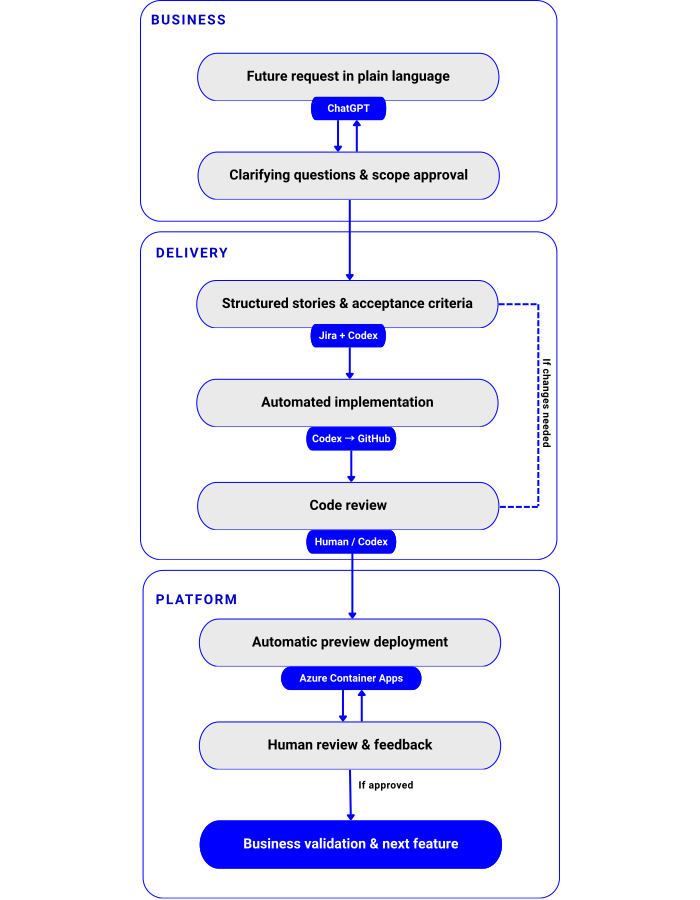
This is the core of an agentic SDLC model: each lifecycle step remains human-governed, but AI coding agents like OpenAI Codex dramatically accelerate implementation, and each phase is connected to the next. Instead of fragmented handoffs, delivery becomes one continuous execution flow.
We applied this model to improve Unit8’s GenAI HyperScaler, which is deployed with multiple enterprise clients. The impact is tangible: less coordination overhead, faster iteration for new features, and stronger traceability from business request to validated outcome.
Connected Flow in Practice
Imagine using your familiar ChatGPT Enterprise workspace and being able to request a new feature or software solution directly from the same interface you already use every day. Inside your usual chat, you can describe what you need, refine the idea collaboratively, and submit your request with ease. From first concept to final delivery, you stay informed at every step of the development process. Watch the full cycle, from feature request to deployed preview.
Where Time Is Saved (Step by Step)
The main gain is not only faster coding, but faster delivery of features.
- Scope clarification: guided AI clarifying questions reduce long asynchronous back-and-forth before implementation starts.
- Story decomposition: once the scope is approved, structured user stories and clear acceptance criteria are generated quickly, reducing planning delays while taking the existing implementation into account.
- Implementation and PR creation: AI-assisted execution streamlines delivery by reducing handoff friction and accelerating pull request readiness. It supports feature development, test implementation, and iterative fix loops covering security checks, test execution, and documentation updates.
- Preview validation: automatic deployment removes manual environment setup and coordination delays.
- Feedback loop: comments and fixes stay in one connected flow, reducing restart overhead and context loss.
In observed runs of this workflow, the full cycle from feature request to deployed preview can be completed in about 30 minutes for suitable feature scope. A comparable non-AI-assisted flow for similar scope typically takes around 3 hours, which implies an approximate time saving of 85%. That speed comes from lifecycle connectivity, not from skipping governance. These metrics were collected from over dozens of feature implementation runs.
From Manual Coordination to AI-Assisted Lifecycle
The shift is operational and shows up in a few concrete ways:
- Less manual coordination, with work moving through more connected workflows
- Better visibility, with progress reflected in clear delivery artifacts rather than scattered status updates
- Greater continuity, with less need to repeatedly transfer context across teams and stages
People still define intent, validate quality, and decide when something is ready for release. AI agents support execution and handoffs, helping teams spend less time on coordination and more time on high-value decisions.
Governance by Design
What makes this model enterprise-ready is not only speed, but built-in governance. In practice, governance stays explicit at every critical checkpoint:
- Human approval gates: scope approval before build, review approval before acceptance.
- Traceable decision trail: requirement, story, PR, preview, and feedback remain linked through delivery artifacts.
- Controlled execution scope: AI agents operate within defined task boundaries instead of open-ended autonomy.
- Review-first operating model: generated outputs are validated by people before downstream decisions.
- Safer iteration loop: feedback re-enters the same controlled workflow instead of spawning ad-hoc side channels.
This keeps accountability clear while still benefiting from AI-assisted acceleration.
Why This Matters for Software Organizations
Most delivery delays come from transition friction between teams, tools, and phases. Agentic SDLC reduces this friction while keeping control explicit:
- business and engineering work against the same artifact trail
- progress becomes observable in real time
- iteration cycles tighten without lowering quality gates
- delivery scales with greater consistency across features
This aligns with the integrated-agent perspective in Unit8’s article on moving from chat to execution: From Everyday Chat to Integrated Agents.
Takeaway
The core takeaway is simple: agentic SDLC delivers business value when speed and governance improve together.
For enterprise products like GenAI HyperScaler, this means:
- AI agents accelerate repetitive SDLC transitions.
- Human teams retain decision authority at critical checkpoints and can fully take over implementation when necessary.
- The full delivery chain stays connected, traceable, and easier to scale.
In other words, this is not automation for its own sake. It is a practical operating model for delivering more features, with better control, in less time.
