- Mar 26, 2026
- 8 minutes
Written By
- Rudolf Höhn – Dias
The Real Cost of Living with Legacy Systems
Most enterprises don’t have a data problem. They have a reconciliation problem.
Somewhere in your organisation, a skilled underwriter is spending half their day copying data between Excel sheets and ERP systems, time that could be spent assessing risk, aligning decisions to internal guidelines, and doing the work they were actually hired to do. The same story plays out in procurement, finance, and operations: talented people, bottlenecked by the technical limitations of a fragmented tool landscape.
This is the starting point for any honest conversation about enterprise data migration. It isn’t really about moving tables from one database to another. It’s about reimagining business processes that have quietly adapted and degraded around the gaps in your IT infrastructure.
When organisations set out to consolidate legacy ERP systems, migrate to SAP S/4HANA, or retire a patchwork of siloed tools, the ambition is right. The problem is the method.
Why Traditional Migration Gets Stuck
Enterprise data migrations are notoriously difficult to execute on time and on budget. The reason isn’t a shortage of expertise; it’s a structural one.
Traditional approaches segment the work across specialised teams: extraction, transformation, validation, and business sign-off. Each group operates with its own tools, context, and limited visibility into what the others are doing. When validation fails, teams trace errors back through the pipeline, by which point upstream processes have already moved on. The cycle restarts. What was projected as a 12-month project becomes a multi-year engagement.
Point-solution AI tools have done little to solve this. Accelerating individual steps doesn’t address the underlying fragmentation. A faster pipeline between disconnected teams is still a disconnected pipeline.

A Different Architecture: The Palantir AIP Approach
Palantir AIP approaches the migration challenge from a fundamentally different angle: instead of automating individual steps, it maintains a unified understanding of the entire migration lifecycle.
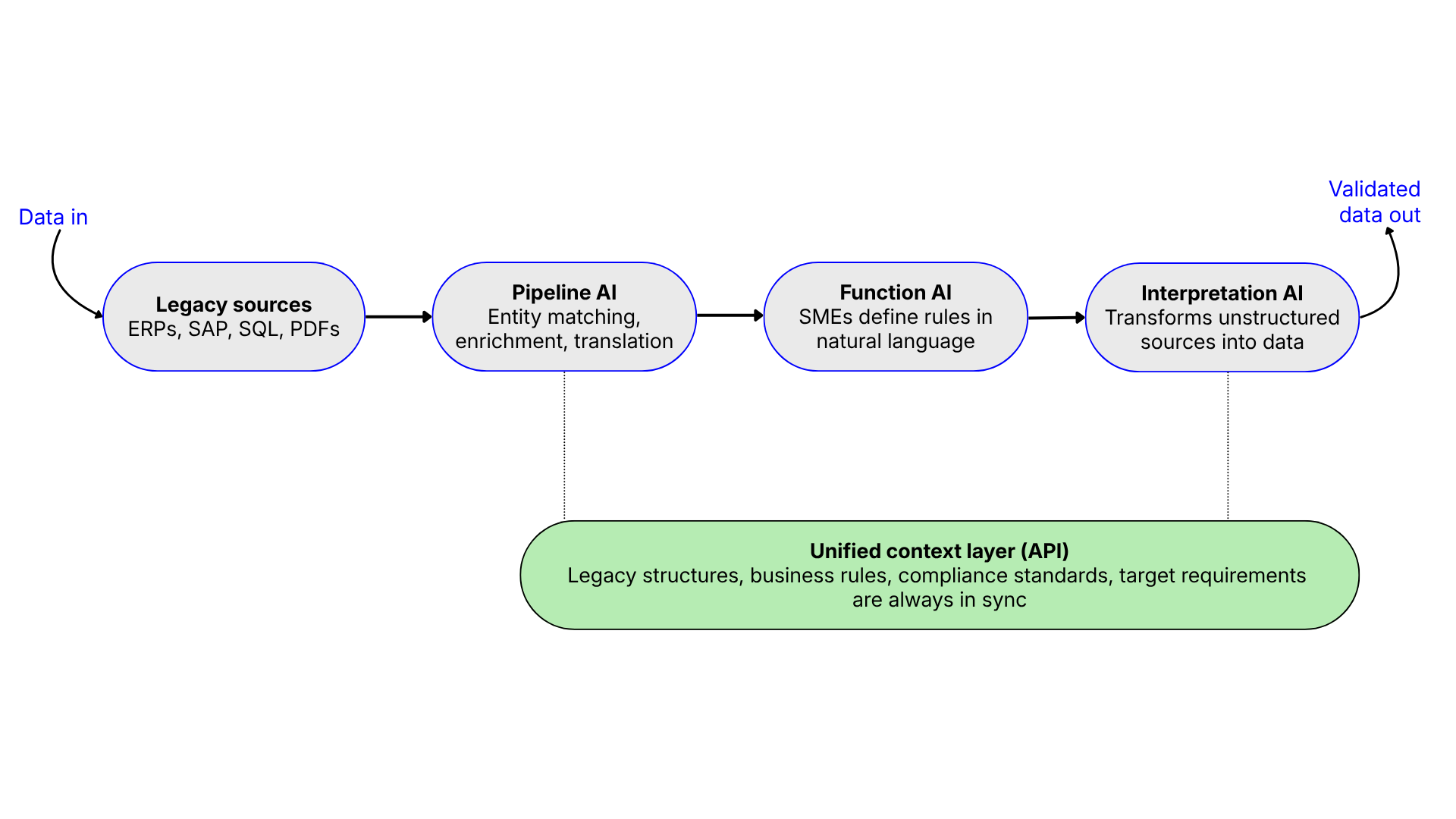
The idea is best understood through the octopus analogy Palantir uses to describe its architecture. An octopus has arms that each contain independent neural processing, capable of acting autonomously, but all coordinated by a central brain that holds the full picture. AIP works the same way: specialised AI capabilities operate at each stage of the migration (data understanding, mapping, transformation, validation), while a central contextual layer maintains awareness of legacy system structures, target requirements, business rules, and compliance standards simultaneously.
What this means in practice is significant. When a validation error surfaces, the system doesn’t just flag it. It identifies where in the pipeline the error originated, propagates the correction across all downstream stages, and updates validation metrics within minutes. A question like “if we remap these legacy product material types, what effect does that have on final upload validation?” no longer requires waiting for a consultant to rerun the pipeline two weeks later. It gets answered immediately.
What Changes for Business Users
The shift in user experience is as important as the technical architecture.
In a traditional migration, subject matter experts, the people who understand the business logic embedded in legacy systems, are consulted periodically and reactively. They get pulled into meetings when something breaks, asked to interpret a process they haven’t touched in months, and then pushed back out of the loop.
With AIP, SMEs interact with the migration directly, through natural language interfaces that let them describe transformation rules, flag exceptions, and validate outcomes without writing code or filing tickets. A procurement lead can instruct the system to swap overseas suppliers for domestic alternatives before data is uploaded to S/4HANA. The pipeline re-executes. Validation updates. No sprint scheduled, no consultant called.
This matters beyond convenience. When the people who understand the business are empowered to act on the data directly, the quality of migration outputs improves and so does ownership of the result.
The Technical Layer: How AIP Handles Data Understanding and Transformation
For those closer to the technical side of migration projects, it’s worth understanding how AIP handles the early and often most time-consuming phase: data understanding.
Legacy systems frequently hold decades of institutional knowledge in the form of custom code, undocumented business logic, and data stored across ERPs, SAP instances, SQL Server databases, and Excel-based workarounds. Interpreting this landscape manually requires extensive documentation reviews, SME interviews, and often significant reverse engineering.
AIP accelerates this by connecting simultaneously to multiple source types, including data dictionaries, legacy documentation stored in PDFs, business requirements captured in spreadsheets, and compliance frameworks in regulatory documents, and constructing a comprehensive data model automatically. Once the baseline is established, it begins querying source databases directly, identifying table relationships and key matching columns.
From there, the platform deploys AI-powered processes at three levels:
Pipeline-level AI handles automated entity matching, data enrichment, and value translation directly within ETL workflows. This eliminates the dependency on specialised integration teams for routine transformation tasks while preserving existing access controls.
Function-level AI supports the SME-facing layer, allowing business users to define transformation rules through natural language and have those rules executed with technical rigour, without requiring them to understand the underlying pipeline architecture.
Interpretation AI extracts structured information from unstructured sources: engineering components from diagrams, compliance requirements from regulatory PDFs, or business logic from legacy documentation that was never properly recorded.
The combination means that both the technical team and the business team are working within the same environment, against the same data model, with continuous visibility into how each action affects the whole.
Continuous Validation: Replacing the Gate with a Feedback Loop
Perhaps the most consequential change in AIP’s approach to migration is how it handles validation.
In a traditional migration, validation is a checkpoint, a binary gate at the end of a phase. Data either passes or it doesn’t. When it doesn’t, the investigation begins and the timeline slips.
AIP reconceptualises validation as a continuous feedback mechanism that runs throughout the migration lifecycle. Validation metrics update in real time as data flows through transformation pipelines. When issues arise, such as records without appropriate matches, columns requiring SME review, or compliance thresholds not yet met, the system surfaces the specific problem along with the tools to address it. Corrections are fully documented and auditable: reasoning, data lineage, transformation logic, and validation outcomes are captured automatically rather than reconstructed manually after the fact.
The practical result is a compression of timelines that, on paper, looks almost implausible. Migration plans that traditionally require six months of consultancy work and significant investment can be generated in a fraction of that time, with execution beginning from day one rather than after a prolonged discovery phase.
Migration as a Starting Point, Not a Destination
One of the more underappreciated aspects of AIP’s architecture is what it enables after the migration event itself.
The same contextual awareness that accelerates migration can be repurposed for ongoing operational intelligence: real-time visibility into business metrics, continuous process optimisation, and the ability to model the downstream impact of decisions before they are executed. Crucially, organisations can begin building applications on top of both legacy and target systems during the migration, rather than waiting for decommissioning to complete. Business continuity is maintained. Value is captured earlier.
This is the shift from migration as a disruptive event to migration as a strategic inflection point, the moment an organisation stops managing around the limitations of its legacy environment and starts operating with the full picture available.
What We've Seen in Practice
At Unit8, we have supported enterprise clients through complex ERP migration programmes on Palantir Foundry, including large-scale consolidations involving multiple legacy systems migrating to SAP S/4HANA. Across those engagements, a consistent pattern emerges: the organisations that realise the most value from AIP are not the ones that use it simply to automate what they were already doing. They are the ones who use it to rethink which processes need to exist at all.
The underwriter who spent half their day on manual reconciliation shouldn’t need to do that. The procurement team shouldn’t be managing supplier decisions through spreadsheets. Data migration, done with the right platform and the right approach, is the opportunity to close that gap, not just technically, but operationally.
Getting Started
If your organisation is planning a legacy system consolidation, an SAP modernisation programme, or a broader ERP migration, the architecture decisions you make now will determine whether you arrive at the destination faster or simply spend more on the same frustrating journey.
We would be happy to discuss how Palantir AIP could fit your specific migration context, whether you are at the planning stage or already mid-stream.