- Apr 14, 2026
- 8 minutes
Written By
-
 Alex Dean
AI tools are everywhere. But giving your employees access to them is not the same as adopting AI.
Many organizations rush to deploy enterprise AI assistants, rolling out hundreds or thousands of seats, only to find that usage stalls, productivity gains remain anecdotal, and leadership is left wondering what went wrong. The issue is rarely the technology. It is the absence of a structured adoption strategy around it.
Why most enterprise AI rollouts don't deliver
The pattern is familiar. An organization secures licenses for an enterprise AI assistant, announces the rollout internally, perhaps sends a short email with a link, and waits for transformation to happen. It doesn’t.
Without context, training, or a clear understanding of what AI can and cannot do, most employees struggle from the very first interaction. They don’t know how to prompt the model effectively, so the answers they get back feel generic, shallow, or off the mark. After a few underwhelming exchanges, the conclusion is predictable: “This tool isn’t good enough.” But the tool is not the problem. The problem is that no one showed them how to use it. Beyond basic prompting, most employees also don’t know how to work with an AI assistant over longer, multi-step tasks — how to refine outputs iteratively, how to give the model context, or how to break complex work into manageable prompts. They try once, get a mediocre result, and give up. A month later, the organization has spent its budget, leadership sees low adoption numbers, and AI is quietly labeled as “not ready for us.”
The data confirms this. According to Deloitte’s 2026 State of AI in the Enterprise report, while 42% of companies believe their strategy is ready for AI adoption, far fewer feel prepared when it comes to infrastructure, data, risk management, and talent. The gap between intention and execution is where most rollouts fail.
This is not a technology failure. It is an adoption failure, and it is entirely avoidable.

The AI skills gap is the biggest barrier, not the tools
One finding stands out across nearly every major enterprise AI report in 2026: the skills gap is the number one obstacle to successful AI integration. Deloitte found that education, not workflow redesign or new role creation, was the primary way companies adjusted their talent strategies in response to AI.
And it makes sense. Cutting-edge AI tools are of limited value if the broader workforce is not prepared to use them. A 2024 survey found that 78% of executives feel AI is advancing too fast for their organization’s training efforts to keep up. Yet 82% of companies in early stages of AI maturity still have not implemented a training or talent strategy to prepare employees for AI-driven workflows.
This is the core challenge. Enterprise AI adoption in 2026 is not a licensing problem. It is a readiness problem.

Your workforce is already using AI, just not the way you think
Here is a reality that many enterprises overlook: employees are already working with AI. They are using ChatGPT, Claude, and other publicly available tools to draft emails, summarize documents, brainstorm ideas, and write code. They are doing this on their own, with their own accounts, outside of any governance or security framework.
Research confirms this is widespread. A recent Larridin report found that 98% of organizations have unsanctioned AI tools in use, so-called “shadow AI”, with associated spend that often exceeds formal IT budgets for AI.
This creates two risks. First, sensitive company data may be flowing into consumer-grade AI tools without any oversight. Second, employees are building AI skills and habits that the enterprise is not capturing, guiding, or leveraging.
Your workforce will use AI regardless. The real question is whether you will be ready to channel that momentum productively, with the right tools, guardrails, and enablement in place.
Why AI literacy is the foundation of any adoption strategy
Before any enterprise AI deployment can succeed, people need to understand what they are actually working with. This goes beyond a quick tutorial on how to write a prompt.
AI literacy in a business context means understanding how large language models generate responses, and why they sometimes get things wrong. It means knowing what hallucinations are, why they happen, and how to identify them in day-to-day business tasks. It means developing judgment about when to trust an AI-generated output and when to verify it manually. And it means learning which tasks genuinely benefit from AI assistance, and which do not.
Without this foundation, employees either over-rely on AI (accepting outputs uncritically) or under-rely on it (dismissing the tool after one disappointing experience). Neither outcome delivers the productivity gains the organization is looking for.
The training impact is measurable. Organizations with formal AI training programs report significantly higher user proficiency, satisfaction, and productivity gains compared to those without, a finding consistently backed by enterprise AI research in 2026.
From awareness to adoption: a structured AI adoption framework
At Unit8, we have seen firsthand, across 350+ data and AI projects, that the organizations achieving real value from AI are the ones that treat adoption as a structured program, not a product rollout.
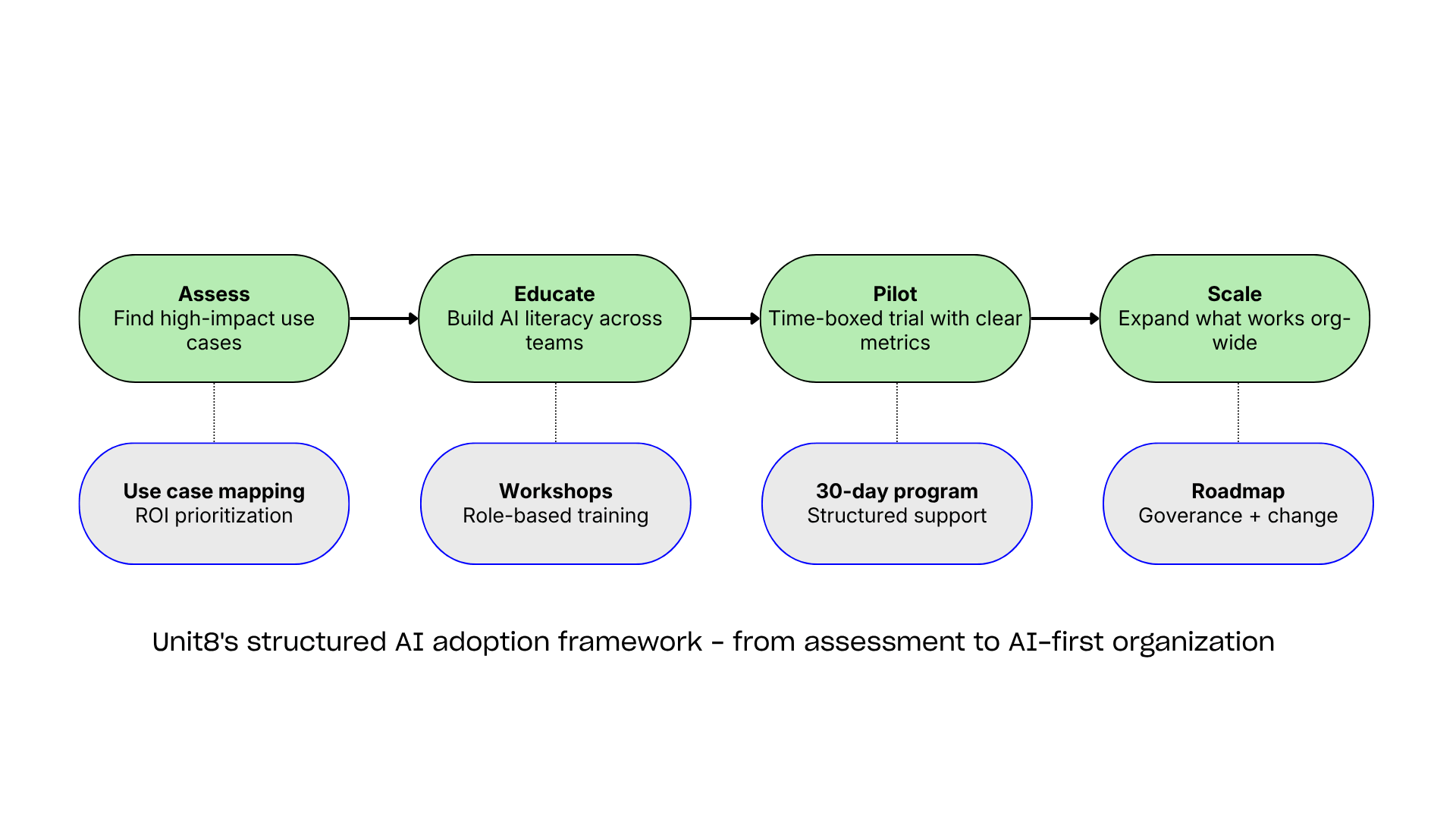
A successful enterprise AI adoption journey typically follows four stages.
Assess. Understand where AI can create the most value across your organization. Identify high-impact use cases, map them to business outcomes, and prioritize based on feasibility and potential return. Not every department or workflow will benefit equally. The goal is to find the highest-leverage starting points.
Educate. Equip your people with AI literacy. Run structured workshops that go beyond prompt engineering basics and into practical, role-specific applications. Help employees understand how AI fits into their actual daily workflows, not in theory, but through hands-on exercises using real company scenarios.
Pilot. Deploy AI tools in a focused, time-boxed manner. A one-month pilot with a defined group of users, clear success metrics, and structured support is far more valuable than a blanket rollout to the entire organization. This is where you learn what works, what does not, and where the real productivity drivers are.
Scale. Based on pilot learnings, build a roadmap to expand AI capabilities across the organization. This includes governance, change management, and ongoing enablement, because adoption is not a one-time event. It is a continuous process.
The real investment is not the tool, it is the enablement
One of the most common misconceptions we encounter is that AI adoption is primarily a licensing decision. Organizations focus on securing seats, negotiating contracts, and choosing between vendors, and then assume the hard part is done.
In reality, the tool is the easiest part. The real investment is in the structured program around it: the literacy training, the use-case identification, the pilot design, the change management, and the roadmap for scaling what works.
This is where programs like the ChatGPT Guided Evaluation become genuinely powerful. The program offers up to 1,000 seats free for one month, giving organizations the chance to put a capable AI assistant directly into the hands of their people — with no licensing cost and no procurement friction. It removes the vendor debate from the equation and lets teams focus on what actually matters: discovering where AI creates value in their specific workflows.
That is a significant advantage. Instead of spending months negotiating contracts before anyone touches the tool, your teams can start building real hands-on experience immediately. Employees get to test AI on their actual work, in their actual roles, and the organization gets to observe genuine usage patterns rather than relying on hypotheticals.
But here is where the “Guided” part becomes critical. A thousand free seats are only as valuable as the structure you wrap around them. Without a clear plan, most of those seats will go unused, and the organization will learn nothing. The real opportunity is to treat the Guided Evaluation as a strategic pilot: pair the tool access with structured onboarding, AI literacy training, and defined success metrics. That way, by the end of the month you have not just tested a product — you have captured measurable impact data, built internal AI capability, and created a credible business case for a full-scale rollout.
The organizations that get the most out of programs like this are the ones that use the free licensing window to simultaneously drive AI literacy and prove ROI — turning a trial into a launchpad.
Why acting now matters
The enterprise AI landscape in 2026 is defined by a clear pattern: broad access is easy, but durable value is hard. Most enterprises sit somewhere between experimentation and early scaling. The organizations that invest in structured adoption now, building the foundations of AI literacy, governance, and change management, will be the ones that reach full operational AI maturity fastest.
Meanwhile, the alternative, waiting for the technology to “mature” or for clearer industry standards, carries growing risk. Your competitors are moving. Your employees are experimenting on their own. And the gap between organizations that adopt AI strategically and those that do not is widening every quarter.
Getting started with enterprise AI adoption
If your organization is exploring AI adoption, whether you are just getting started or looking to move beyond initial experiments, Unit8 can help. We work with enterprises to design and execute structured AI adoption programs that combine AI literacy, use-case identification, hands-on enablement, and strategic roadmapping.
And if you want to accelerate your journey, we can help you make the most of the ChatGPT Guided Evaluation, turning 1,000 free seats into a structured pilot that delivers real, measurable insights into how AI can transform the way your organization works.
Ready to move from AI curiosity to AI-first? Get in touch.